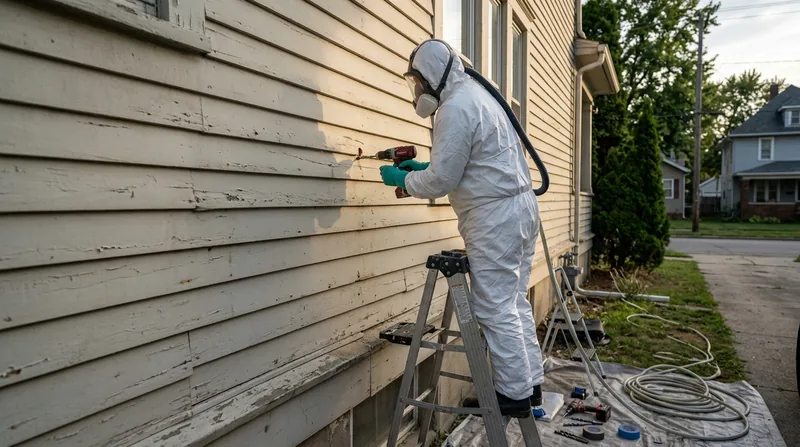




Wall & Injection Foam Insulation in South Bend solves a problem that hits hardest in the oldest neighborhoods downtown and near Notre Dame: heat bleeding straight through open wall cavities in balloon-framed homes built in the early 1900s. South Bend's vintage housing stock, built when energy codes did not exist, sits over full basements in a climate zone 5A winter that runs cold and humid from November through March. The St. Joseph River valley funnels lake-effect snow off Lake Michigan, and those months of sustained cold drive moisture outward from your heated living space toward the exterior, making every gap in the wall cavity a path for heat loss and condensation risk. Injection foam fills those cavities without tearing open the walls, seals the air leaks, and stops the thermal bleed. We drill small access holes, inject closed-cell or open-cell foam into the cavity, and patch the siding so the work is invisible from the street.
Why Wall & Injection Foam Matters in South Bend's Historic Homes
Balloon-framed walls were the standard construction method for homes built before 1950 in South Bend, Mishawaka, and surrounding towns. Unlike modern stick-framed walls, balloon framing runs studs continuously from the basement sill to the roof line with no fire stops or blocking between floors. This means the wall cavity acts as a vertical duct, moving warm air straight up and out through the attic or roof, and pulling cold air down from outside. A 1910 Craftsman near downtown South Bend or a Victorian near the river loses heat through those cavities all winter. Fiberglass batts, if they were ever installed, have sagged and left gaps at the top plates. Injection foam seals the entire cavity in one operation, stops convective air movement, and holds its R-value for decades.
- Stops warm air from rising through open wall studs and escaping into the attic.
- Seals air leaks at rim joists, sill plates, and electrical penetrations where drafts enter from outside.
- Holds R-value without settling, unlike blown-in fiberglass that compacts over time.
- Eliminates the cost and mess of removing old insulation or tearing open walls to install new batts.
- Reduces heating bills during the long South Bend winter by keeping interior walls warmer and cutting the load on your furnace.
Wall injection foam is the only practical retrofit for closed-wall cavities in homes where the exterior is clapboard, brick, or stone and tearing into the walls is not an option.
Local example: A 1920s bungalow in South Bend's Walnut Hill neighborhood with balloon-frame walls, clapboard siding, and original 2x4 studs loses 30 to 40 percent of its winter heat through uninsulated cavities. Injection foam fills those cavities completely, restores the wall's thermal resistance, and costs far less than replacing the siding and gutting the interior.
For more on how to verify contractor credentials and understand local permitting, consult the Indiana Department of Natural Resources and your city's building department, which governs thermal barrier and ignition barrier requirements under the current energy code.
How Wall & Injection Foam Insulation Works: Our Process in South Bend
Wall injection is a straightforward, non-invasive process. We locate the wall cavities, drill small access holes through the siding (usually 1 to 1.5 inches, spaced vertically to reach the full height of the cavity), inject foam under controlled pressure, and patch the holes so they blend with the existing siding. The entire operation takes one to two days depending on the wall area, and we handle all patching and cleanup. Because the work happens from the exterior and the foam expands to fill the cavity completely, there is no need to remove insulation or disturb the interior of the home.
- We assess the wall cavity depth and condition, identifying any moisture, settling, or obstruction that would block foam flow.
- We drill access holes at strategic points along the exterior wall, sized to allow the foam hose to reach into the cavity.
- We inject closed-cell or open-cell foam, depending on your climate zone and the wall's moisture profile, at the correct ratio and drum temperature.
- We monitor the foam cure during the application window, ensuring full cavity fill without voids or incomplete coverage.
- We patch all access holes with matching siding material or caulk, restoring the exterior appearance.
- We allow the foam to cure fully (typically 24 to 48 hours) before the wall is considered complete and ready for normal use.
The closed-cell foam we use in South Bend walls provides an R-value of 6.5 to 7.0 per inch and carries a vapor-closed profile, which is critical in climate zone 5A where moisture drives outward through the wall for most of the heating season. Open-cell foam (R-value 3.5 to 3.6 per inch) is moisture-permeable and suits walls where vapor management requires breathability; we recommend it only when the wall assembly and building science support it. For most historic South Bend homes, closed-cell is the standard choice.
Mishawaka example: A 1950s ranch with 2x4 exterior walls and original fiberglass that has compressed to R-5 or less receives injection foam through the rim joist area and upper wall cavities. The closed-cell foam fills the cavity completely, seals air leaks at the sill, and restores the wall's thermal boundary. Work starts on a Monday morning and is complete by Wednesday afternoon, with minimal disruption to the home.
To understand how wall injection fits into a broader insulation strategy that includes rim joist and band joist sealing, see our rim joist service page.
| Approach | Description | Best for |
|---|---|---|
| Closed-Cell Injection Foam | High-density foam (R-6.5 to R-7.0 per inch) injected into wall cavities; vapor-closed and air-impermeable; expands to fill all voids. | South Bend's climate zone 5A homes; balloon-frame walls; historic neighborhoods where moisture control and air sealing are priorities. |
| Open-Cell Injection Foam | Lower-density foam (R-3.5 to R-3.6 per inch) injected into cavities; vapor-permeable; allows moisture to pass through the wall assembly. | Walls where building science requires vapor permeability; retrofit of homes with vapor-open exterior cladding and interior vapor barriers. |
| Partial-Cavity Injection | Foam injected into the upper portion of a wall cavity where old insulation has settled, leaving a gap at the top plate. | Homes with failed or settled fiberglass; quick top-up of walls that do not require full cavity fill; budget-conscious retrofits. |
| Full-Cavity Injection with Rim Joist Sealing | Complete wall cavity fill combined with foam injection into the rim joist and band joist areas where walls meet the foundation. | Comprehensive thermal envelope upgrade; homes over full basements (standard in South Bend); maximum air sealing and heat retention. |
Wall & Injection Foam Insulation Cost in South Bend: What to Expect
Wall injection foam pricing depends on the wall area, cavity depth, foam type (closed-cell or open-cell), and accessibility. In South Bend and surrounding areas, most wall injection jobs run from $2 to $4 per square foot of wall surface, with closed-cell foam at the higher end of that range due to its superior R-value and vapor profile. A typical 1,200-square-foot single-story ranch with 1,500 to 2,000 square feet of exterior wall surface (accounting for windows, doors, and foundation) costs between $3,000 and $8,000 depending on foam type and the extent of the work. A two-story colonial or Victorian near downtown South Bend, with 3,000 to 4,000 square feet of wall area, can run $6,000 to $16,000 or more if the entire exterior is treated.
Factors that move the cost up include balloon-frame construction (which requires more careful drilling and monitoring), difficult access on narrow lots or near dense landscaping, masonry or brick exteriors (which require specialized drilling), existing moisture in the cavity (which must be addressed before foam application), and the height of the home (two-story and three-story work requires scaffolding or lifts). Partial-cavity injection (topping up settled fiberglass in the upper wall only) runs lower, typically $1.50 to $2.50 per square foot, because less foam is needed.
We always provide a written estimate with the R-value and thickness of the foam specified, the square footage of wall to be treated, and the travel time included in the price. There is no charge for the estimate itself, and we respond within 24 hours. To see our full pricing overview and get a sense of how wall injection fits into the cost of a complete insulation retrofit, visit our pricing page.
The best way to lock in an accurate price is to request a free estimate. Call us at (574) 406-8438 or contact us online and we will schedule a time to walk the exterior, assess the wall cavities, and provide a firm number.
Wall & Injection Foam Insulation Near Me: What to Look for When Hiring a Contractor in South Bend
Hiring the right spray foam contractor is critical because the quality of the installation determines whether the foam seals properly, cures correctly, and holds its R-value. A bad installation, marked by incomplete cavity fill, incorrect drum temperature, or immediate re-entry before the foam has cured, can leave voids, off-gassing odors, and reduced thermal performance. When you are evaluating contractors in South Bend, Mishawaka, Granger, or surrounding towns, here is what to verify.
- Ask for a written estimate that specifies the R-value per inch, the thickness of foam to be applied, and the square footage of wall to be treated; an estimate with no technical specs is a red flag.
- Verify that the contractor is fully insured and ask to see a certificate of insurance; do not accept verbal assurance or a promise to "get you a copy later."
- Request references from previous jobs in South Bend or nearby towns, and call at least two to ask about the quality of the work, the professionalism of the crew, and whether any odor or re-entry issues occurred.
- Confirm that the contractor will provide mechanical ventilation during the cure period and will specify a 24 to 48-hour re-entry window before the home is fully occupied.
- Ask whether the contractor pulls permits or helps you navigate what applies at your address; permitting varies by city, and the contractor should know the rules for South Bend, Notre Dame, Mishawaka, or wherever your home is located.
- If your home is in a historic district or under HOA architectural review, ask the contractor to confirm that the exterior patching (siding repair or caulk color) will meet those guidelines; wall injection is usually invisible, but patching quality matters.
The contractor you hire should be able to explain why closed-cell foam is the right choice for South Bend's climate zone 5A and moisture profile, and should be willing to walk away from a job if the wall cavity is wet, contaminated, or blocked. That honesty is the strongest signal of a professional shop.
Ready to get started? Contact us for a free estimate and we will assess your walls, explain your options, and provide a firm price with no obligation to book.
Wall & Injection Foam Insulation in South Bend: Pricing Guide
| Service | Price | Details |
|---|---|---|
| Wall Injection Foam (Closed-Cell) | Starting at $2/sq ft | Closed-cell foam at R-6.5 to R-7.0 per inch; best for South Bend climate zone 5A; price reflects wall area and cavity depth |
| Wall Injection Foam (Open-Cell) | Starting at $1.50/sq ft | Open-cell foam at R-3.5 to R-3.6 per inch; vapor-permeable; lower cost but used only when building science requires breathability |
| Partial-Cavity Top-Up (Settled Fiberglass) | Starting at $1.50/sq ft | Foam injected into upper wall cavity only; addresses settled insulation without full cavity fill; lowest cost option for minor gaps |
| Comprehensive Wall and Rim Joist Sealing | On estimate | Full-cavity wall injection combined with rim joist and band joist foam; requires on-site assessment to determine total square footage and complexity |
| Travel and Estimate | Included / Free | No mileage fee in South Bend and surrounding service areas; free written estimate with 24-hour response time |
Indicative pricing, the exact cost depends on square footage, finish, and site access. Free personalized estimate within 24h at (574) 406-8438.


