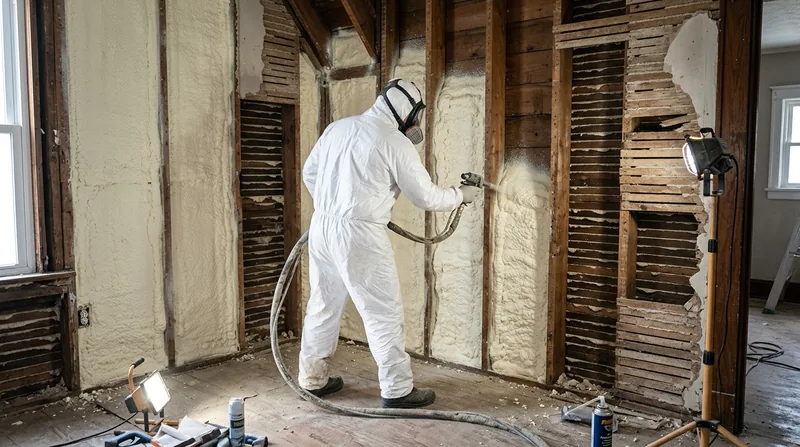




South Bend's neighborhoods are a mixed timeline of insulation failures. Early-1900s homes from the Near Northside through Riverside Park carry insulation replacement and re-insulation as their single biggest energy leak: open wall cavities in balloon-framed walls, settled mineral wool that leaves gaps at top plates, and fiberglass batts that sag away from rim joists over decades of basement moisture. Postwar ranches in Mishawaka and Granger added insulation in the 1960s, but that material has compacted and lost R-value, while newer construction sits over full basements where the rim and band joist still bleeds cold air all winter. This is IECC climate zone 5A, and the heating season here runs from October through April with sustained sub-freezing temperatures and lake-effect snow off Michigan. When old insulation fails, heat escapes through walls, attics, and basement rim joists, and your energy bills climb every month. We remove failed insulation and replace it with spray foam and air sealing that closes every cavity, stops thermal loss, and holds heat through the long Michiana winter.
Why Insulation Replacement & Re-Insulation Matters Most in Early South Bend Homes
South Bend was built in waves, and each wave left insulation problems. The frame homes of the early 1900s, especially in neighborhoods near the St. Joseph River and around Notre Dame, were never designed for modern climate control. Their open wall cavities and uninsulated rim joists were acceptable then; they are catastrophic now. Postwar ranches added fiberglass batts, but mineral wool settles, fiberglass loses R-value as it compacts, and both materials fail at penetrations where electrical wiring, plumbing, and HVAC ducts pass through. When you heat a South Bend home through a 120-day winter with failed insulation in the walls, you are paying to heat the neighborhood.
- Open wall cavities in 1900s balloon-framed homes leak heat directly to the exterior siding and have never been sealed.
- Settled mineral wool and compressed fiberglass lose 20 to 40 percent of their original R-value over 40 to 60 years.
- Gaps at top plates, around electrical boxes, and at rim joists are where the most air leakage happens and where spray foam stops it.
- Moisture from basement humidity migrates into wall cavities all winter, degrading fiberglass and mineral wool further.
- Replacing failed insulation with closed-cell spray foam closes every cavity and eliminates thermal bridging through studs and framing.
Insulation replacement is not cosmetic. It is the foundation of energy efficiency in a South Bend home built before 1980.
Key info: South Bend's building code requires that spray foam insulation in walls meet a thermal barrier or ignition barrier within 15 minutes of flame exposure. Your local building department in South Bend, Mishawaka, or Granger sets the rule for your address. We follow code for your jurisdiction and provide written estimates with R-value and thickness specifications so you know exactly what you are getting. Verify any contractor's compliance with your city before signing a contract.
For more on how we approach wall insulation retrofit, see our wall and injection foam insulation service.
How We Replace Insulation in South Bend Homes: The Process
Insulation replacement is not a one-step job. We start by inspecting what is already there, determining what can stay and what must come out, then removing failed material, sealing air leaks, and installing new spray foam or blown-in insulation depending on the cavity and the end goal. Every job is different because every South Bend home is different. A 1920s frame house near downtown has different cavity geometry than a 1970s ranch in Granger, and a basement rim joist job is a different scope than a wall retrofit. We measure on site, write an estimate with R-value and thickness, and explain what we are doing and why before we start.
- We inspect the existing insulation, identify failed sections, and determine what must be removed and what can remain.
- We remove old insulation, fiberglass, mineral wool, or degraded foam using industrial vacuums and containment.
- We seal air leaks at rim joists, top plates, electrical penetrations, and around ductwork with spray foam or caulk.
- We install new spray foam or blown-in cellulose to the specified R-value and thickness, per code for your address.
- We allow proper cure time and provide re-entry guidance before you return to the space.
The result is a sealed, insulated cavity that stops heat loss and holds R-value for decades, not the 40-year decline you see in mineral wool.
Local example: A 1950s ranch in Mishawaka had 2 inches of settled fiberglass in the walls and no rim joist insulation. The basement stayed 48 degrees all winter. We removed the failed batts, sealed the rim joist with 2 inches of closed-cell spray foam, and re-insulated the walls with 3.5 inches of open-cell foam in the cavities. The basement temperature rose 8 degrees, and the heating bill dropped $90 a month. The entire job took three days.
Learn more about our insulation removal service and the air sealing that comes with it.
Insulation Replacement Methods: Which One for Your Home
| Approach | Description | Best for |
|---|---|---|
| Closed-Cell Spray Foam Replacement | High-density foam sprayed to 2 to 3 inches, air-seals as it expands, reaches R-6 per inch, moisture-resistant. | Rim and band joists, basement walls, wall cavities in older homes where moisture is a concern, metal buildings. |
| Open-Cell Spray Foam Replacement | Lower-density foam sprayed to 5.5 to 7 inches, R-3.5 per inch, softer, breathable, sound-dampening. | Attics and wall cavities in dry climates or where vapor permeability is desired, interior wall sound control. |
| Blown-In Cellulose or Fiberglass | Loose-fill insulation blown into cavities, R-3.5 per inch, less expensive, no air-sealing properties, settles over time. | Attic top-ups where existing insulation is sound, simple additions to existing open-cavity walls, budget-conscious jobs. |
| Hybrid: Foam + Blown-In | Spray foam at rim joists and penetrations, blown-in cellulose or fiberglass in wall cavities and attics above. | Large wall retrofit jobs, attics with existing insulation, basements with rim joist focus and wall cavity secondary. |
Each approach has a cost-to-R-value ratio and a best-use case. On a simple attic top-up where the existing insulation is sound, blown-in is the right answer and costs less. On a 1920s South Bend frame house with open wall cavities and a cold basement, closed-cell spray foam at the rim joist and open-cell in the walls is the technical choice. We assess your home and recommend the method that matches your budget and your building envelope.
Insulation Replacement & Re-Insulation Cost in South Bend: What to Expect
Insulation replacement pricing depends on several concrete factors: the size of the area, the type of insulation being removed, whether the cavities are open or closed, access to the space, and the R-value target you choose. A rim joist and band joist replacement in a South Bend basement starts around $2,800 to $4,500 for a typical 1,200-square-foot home. A full wall cavity retrofit in a 1900s frame house with open cavities runs higher because the labor is more involved and the foam volume is greater. An attic re-insulation with removal and replacement runs $3,500 to $6,000 depending on attic size and the R-value target. The best way to know your actual cost is to get a written estimate with R-value and thickness specifications listed for each area.
- Rim joist and basement band joist replacement typically costs $2,800 to $4,500 for a full basement perimeter.
- Wall cavity retrofit in a single story or a section of a house runs $4,000 to $8,000 depending on cavity size and foam type.
- Attic insulation replacement with removal and new spray foam or blown-in insulation ranges $3,500 to $6,500 for a 1,500-square-foot attic.
- Large jobs combining rim joist, wall cavities, and attic work are estimated on site because the scope is unique to each home.
We provide free estimates within 24 hours at (574) 406-8438. Travel is included in South Bend and surrounding areas. See our full pricing overview for more detail on what drives cost in your specific job.
What to Look for When Hiring an Insulation Contractor Near South Bend
Hiring the right insulation contractor is the difference between a sealed, durable installation and a problem you will live with for years. The spray foam industry has two extremes: national franchises that send crews from hundreds of miles away and disappear after the job, and local independents who are reachable and stand behind their work. A bad installation shows itself in the estimate: no R-value or thickness specified, a price far below market with no inspection, no mechanical ventilation during cure, immediate re-entry promised, and insurance that cannot be verified. A good estimate names the R-value and thickness for each area, explains the method and why it fits your home, includes a re-entry window of 24 to 48 hours, and is backed by verifiable insurance.
- Verify that the contractor is fully insured and can provide a current certificate of insurance on request.
- Get estimates from at least two contractors and compare the R-value, thickness, and method specified for each area.
- Ask for references from homes in South Bend or nearby that had similar work done in the past two years.
- Check that the contractor understands your local building code and will help you navigate permitting if it applies to your job.
- Confirm that the contractor has mechanical ventilation equipment on site during spray and a stated re-entry window before you use the space.
South Bend homes are worth protecting with the right contractor. Call us at (574) 406-8438 or request a free estimate. We have been in business since 2011, we are fully insured, and we provide written estimates with R-value and thickness for every job.
Insulation Replacement & Re-Insulation in South Bend: Pricing Guide
| Service | Price | Details |
|---|---|---|
| Rim Joist & Band Joist Replacement | Starting at $2,800 | Full basement perimeter sealed with closed-cell spray foam, includes air sealing at rim board and band joist penetrations |
| Wall Cavity Retrofit (Partial or Full) | Starting at $4,000 | Open or closed cavities re-insulated with spray foam, cost varies by wall area, cavity depth, and foam type chosen |
| Attic Insulation Replacement with Removal | Starting at $3,500 | Old insulation removed, attic sealed and re-insulated to target R-value, cost depends on attic size and R-value target |
| Large Multi-Area Jobs (Basement, Walls, Attic) | On estimate | Scope combining rim joist, wall cavities, and attic requires on-site inspection to determine removal volume and foam thickness needed |
| Travel | Included | No separate mileage or travel fee in South Bend, Mishawaka, Granger, and surrounding service areas |
| Free Estimate | No charge | Written estimate with R-value and thickness specifications, response within 24 hours at (574) 406-8438, no obligation to book |
Indicative pricing, the exact cost depends on square footage, finish, and site access. Free personalized estimate within 24h at (574) 406-8438.


