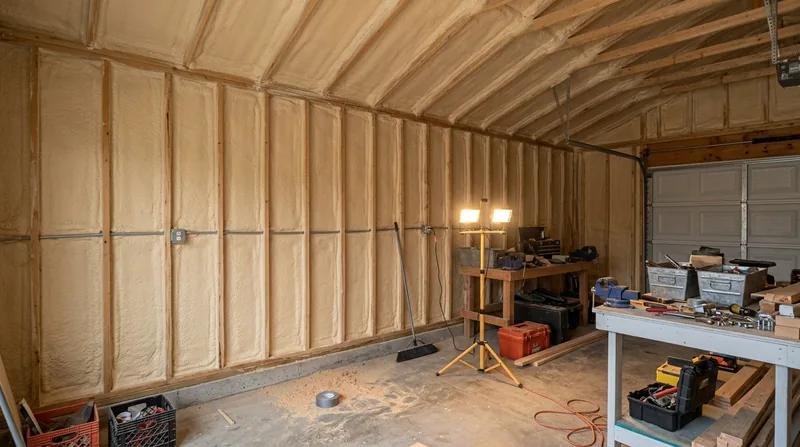




Garage spray foam insulation in South Bend transforms an uninsulated workshop or detached garage from a frozen box into usable workspace through the long Michiana winter. Garages and shops across St. Joseph County sit exposed to the same sustained cold and lake-effect snow that challenges the houses next to them, but they rarely get the insulation attention those homes do. A spray foam ceiling and wall system seals air leaks, holds heat, and keeps tools, vehicles, and work surfaces accessible even when outdoor temperatures drop below zero for weeks at a time. South Bend's postwar garages and newer detached shops lack the thermal envelope they need to fight the climate zone 5A heating season. When you seal a garage with spray foam, you reclaim square footage that would otherwise sit dormant from November through March.
Why Garage Insulation Matters in South Bend's Cold Climate
An uninsulated garage bleeds heat through its ceiling, walls, and rim joist into the attic and basement rim space above and below. That heat loss pulls warm air from the adjacent house if the garage shares a wall with the main structure, forcing your furnace to run longer and harder. In South Bend, where winter lasts five months and temperatures regularly dip into single digits, an unheated garage also creates a thermal bridge that can lead to condensation on metal door frames and freezing pipes if utilities run through the space. Spray foam stops that heat transfer and seals the air leaks that turn a garage into a convective sieve.
- Stops heat loss through the ceiling and side walls, cutting the heating load on the main house.
- Seals rim and band joists where the garage foundation meets the frame, a major air leak point in older South Bend construction.
- Prevents condensation on metal surfaces and cold-weather pipe freezing when utilities are present.
- Creates a usable workshop space where tools stay accessible and hands stay warm enough to work.
- Improves the structural shell if the garage roof or walls have settled or developed gaps over decades.
A properly insulated garage in South Bend or nearby Mishawaka pays for itself in comfort and utility cost reduction over the heating season.
Real example: A 2-car garage in Granger with a 16 x 20 foot ceiling and uninsulated walls loses roughly 40 to 50 percent of its interior heat to the outdoors on a 20-degree day. Closed cell spray foam at 4.5 inches on the ceiling and 3 inches on the walls reduces that loss to under 10 percent, making the space warm enough to work in even when the outdoor temperature is well below freezing.
How We Spray Foam and Seal Your Garage in South Bend
Our process starts with a site assessment to identify the structure type, existing insulation, moisture sources, and ventilation openings. We measure the ceiling and wall areas, identify rim and band joists that need sealing, and determine whether closed cell or open cell foam fits your use case. Closed cell is the right choice for garages because it resists moisture, provides structural rigidity, and delivers high R-value in a thin profile. Once you approve the estimate with R-value and thickness specifications, we schedule the work and prepare the space.
- We set up mechanical ventilation to manage vapors during cure and establish a re-entry window of 24 to 48 hours.
- We spray the ceiling first, building thickness in controlled passes to prevent sag and ensure even coverage.
- We move to the walls, sealing the rim and band joist area where the foundation meets the frame.
- We verify coverage, measure final thickness and R-value on site, and document the work with photos and specifications.
- We remove protective coverings, ventilate the space, and provide written post-cure care instructions.
The entire job typically takes one day for a standard 2-car garage, with cure time managed by ventilation fans and occupancy restricted per manufacturer guidelines.
Local example: A detached garage in South Bend's near-northside neighborhood built in the 1970s with a vented attic and balloon framing in the walls. We sealed the rim joist, sprayed 4.5 inches of closed cell on the ceiling, and 3 inches on the north and west walls facing prevailing winter wind. The work took eight hours, cure time was managed overnight, and the space was fully usable by the next morning.
Garage Spray Foam Insulation Methods and Materials
| Approach | Description | Best for |
|---|---|---|
| Closed Cell Spray Foam | High-density foam (1.5 to 2.0 pounds per cubic foot) with closed cell structure, R-value of 6.0 to 7.0 per inch, low moisture permeability, and structural contribution to walls and ceilings. | Garages where moisture control and high R-value in minimal thickness are priorities; rim and band joists; metal building walls prone to condensation. |
| Open Cell Spray Foam | Lower-density foam (0.4 to 0.5 pounds per cubic foot) with open cell structure, R-value of 3.5 to 3.7 per inch, higher vapor permeability, and sound dampening properties. | Garages used as workshops where sound control is valued and moisture is not a primary concern; budget-conscious insulation on interior walls. |
| Rim and Band Joist Sealing | Closed cell foam applied directly to the concrete foundation rim and wooden band joist, sealing the perimeter where the garage frame meets the foundation and where air leaks are most severe. | Every garage in South Bend; essential for preventing basement and rim joist cold spots and for blocking outdoor air infiltration into the living space above. |
| Ceiling-Only Retrofit | Spray foam applied only to the garage ceiling, leaving side walls uninsulated or minimally treated, reducing cost while capturing the largest heat loss surface. | Garages where budget is tight or side walls already have some insulation; effective for improving comfort without a full shell enclosure. |
Garage Spray Foam Insulation Cost in South Bend: What to Expect
Garage spray foam insulation in South Bend typically starts at $1,200 for a basic 2-car garage ceiling with closed cell foam at 4.5 inches. The final cost depends on the ceiling area, wall coverage, rim joist sealing, existing insulation removal, and site access. A garage with high ceilings, complex framing, or significant air sealing work will cost more. Getting two or three written estimates with R-value and thickness specifications lets you compare not just price but the actual material and coverage each contractor is proposing. See our full pricing overview for detailed breakdowns by scope.
Factors that move the price up include ceiling height above 10 feet, extensive wall coverage, removal of old insulation, sealing of multiple penetrations (electrical outlets, light fixtures, ductwork), and travel time to more distant service areas. A garage with rim joist sealing, full wall coverage, and old insulation removal will run $2,500 to $4,000 depending on the structure size and complexity. Always ask whether the estimate includes mechanical ventilation during cure, post-cure documentation, and a warranty on the installation itself.
What to Look for When Hiring a Garage Spray Foam Contractor Near South Bend
Choosing the right spray foam contractor is more important than choosing based on price alone. A bad installation, even at a discount, leaves you with odor problems, incomplete coverage, incorrect thickness, or foam that fails to cure properly. Look for a contractor who provides a written estimate with R-value and thickness specifications, not just a dollar amount. Verify that the contractor carries full insurance and can provide a current certificate upon request. Ask for references from recent garage jobs in South Bend, Mishawaka, or Granger, and follow up by calling those customers.
Red flags include estimates with no R-value or thickness listed, promises of immediate re-entry (cure takes 24 to 48 hours minimum), pricing far below market with no inspection, and a contractor who cannot be reached after the job is complete. Ask whether the contractor will provide mechanical ventilation during cure and a written post-cure care sheet. Confirm that the foam meets the thermal barrier and ignition barrier requirements of the building code in your city (these vary, so always defer to your local building department). If your garage is in an HOA community, check whether the association has rules about exterior work or material visibility. Call (574) 406-8438 for a free, no-obligation estimate and to discuss your specific garage layout and goals.
Garage Spray Foam Insulation in South Bend: Pricing Guide
| Service | Price | Details |
|---|---|---|
| Garage ceiling only (2-car, closed cell, 4.5 inches) | Starting at $1,200 | Ceiling spray foam with rim joist sealing included; price increases with ceiling height above 10 feet or complex framing |
| Garage ceiling plus walls (2-car, closed cell, full coverage) | Starting at $2,400 | Ceiling and wall spray foam with rim joist sealing and air leakage sealing around penetrations; larger garages or high ceilings increase cost |
| Rim and band joist sealing only (garage foundation perimeter) | Starting at $600 | Closed cell foam applied to the foundation rim where the garage frame meets concrete; cost varies by perimeter length and existing insulation |
| Garage with old insulation removal and replacement | On estimate | Removal cost plus new spray foam installation; estimate required on site to assess volume and disposal requirements |
| Travel and setup | Included | No separate mileage fee or travel charge within South Bend and surrounding St. Joseph County service areas |
| Free written estimate | No obligation | Response within 24 hours at (574) 406-8438; estimate includes R-value, thickness, and detailed scope breakdown |
Indicative pricing, the exact cost depends on square footage, finish, and site access. Free personalized estimate within 24h at (574) 406-8438.


