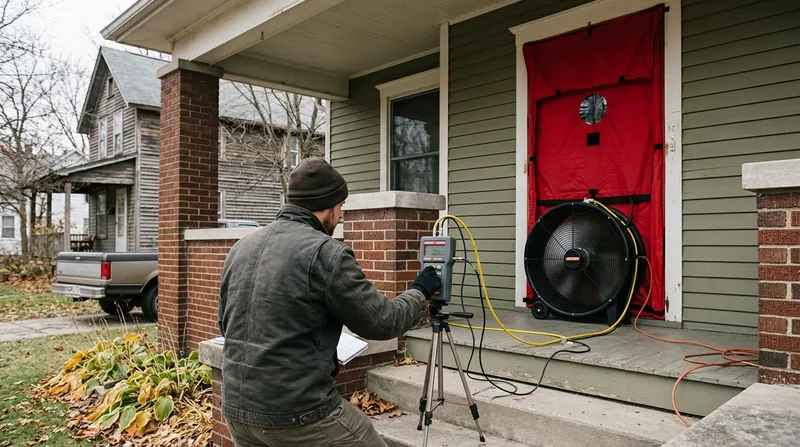




Air sealing in South Bend stops heated air from bleeding out through attic penetrations, rim joists, and wall cavities where stack effect pulls warm indoor air toward the cold outdoors. South Bend's older neighborhoods, built from the early 1900s through the 1960s, sit over full basements and carry balloon-framed walls, open cavities, and rim joists that leak air straight into the foundation rim. Winter here is sustained and cold, with lake-effect snow piling up from Lake Michigan through the heating season, and every month of sustained cold costs money when air escapes unchecked. We seal those gaps with foam and caulk so the blower door test shows fewer air changes per hour, and your heating system does not work against a leaking envelope. Air sealing is the credibility differentiator against fiberglass alone, and it is the foundation of every attic or crawl space retrofit. Call us at (574) 406-8438 for a free written estimate with R-value and thickness specs, or read more about how attic spray foam insulation pairs with air sealing to lock down your top.
Why Air Sealing Matters in South Bend's Cold Climate
Stack effect is the engine of air leakage in South Bend homes. Warm air inside your house is less dense than cold air outside, so it rises and escapes through every gap in the attic, every penetration around pipes and wires, and every seam in rim joists and band joists. The colder it gets outside, the stronger the pull. South Bend sits in IECC climate zone 5A, cold and humid, and the heating season runs long. When you lose conditioned air to the attic, your furnace runs longer to replace it, and your bills climb. Air sealing stops that cycle by blocking the pathways before they matter.
- We identify gaps at the attic rim, around electrical and plumbing penetrations, at the top plates of exterior walls, and at rim and band joists in the basement.
- We seal those gaps with closed-cell or open-cell spray foam, caulk, and mechanical fasteners so air cannot move through them.
- A blower door test before and after shows you the improvement in air changes per hour, the metric that matters to your heating bill.
- Air sealing is not a cosmetic upgrade; it is the structural envelope control that makes every other insulation investment work.
Homes in Notre Dame near the St. Joseph River face ice dams each winter as attic heat melts snow on the roof deck, which then refreezes at the eaves. Air sealing reduces attic temperature rise, cutting the melt-refreeze cycle. Mishawaka ranches built in the 1950s and 1960s have settled insulation and gaps at top plates; Granger subdivisions carry vented attics and unsealed rim joists. All of them bleed air, and all of them benefit from sealing.
Key info: South Bend's St. Joseph County building department governs energy code compliance and permits for insulation work. Verify what applies at your address before you hire. For details, contact your local building department or visit Indiana's energy office.
How We Seal Air Leaks in South Bend Homes
Air sealing is a systematic process. We start with a visual inspection and often run a blower door test to show where air is moving. Then we seal gaps with the right material for each location: spray foam for larger voids and structural seams, caulk for smaller cracks and joints. In attics, we seal around electrical boxes, pipe penetrations, the rim where the attic meets exterior walls, and the top plates of interior walls. In crawl spaces and basements, we seal rim and band joists, sill plates, and any opening where conditioned air can escape. In walls, we inject foam into cavities if they are empty and leaking. Mechanical ventilation during cure keeps the space safe, and we observe the manufacturer's re-entry window before you move back in.
- We walk the attic or basement and mark every gap, penetration, and seam that pulls air.
- We seal electrical boxes and outlet penetrations with closed-cell spray foam to stop air around wires.
- We seal rim and band joists, the weak point in every South Bend basement, with spray foam to block stack effect pull into the rim.
- We caulk smaller cracks and joints with polyurethane or silicone caulk so the seal is continuous and flexible.
- We ensure mechanical ventilation runs during application and curing to manage VOC release and ensure worker and occupant safety.
- We provide a written estimate showing the scope, materials, and thickness of foam applied so you know exactly what you are paying for.
In a South Bend home in Osceola, we sealed an attic where the rim and top plates were open to the exterior, then added spray foam insulation. The blower door showed a 30 percent drop in air leakage before any insulation was added. In Elkhart, we sealed a 1950s ranch basement rim joist where the band joist had no insulation and no sealant; the homeowner reported a noticeably warmer basement by mid-December. See our crawl space spray foam insulation page for more on basement and rim joist sealing.
Real example: A balloon-framed 1920s home in South Bend had exterior walls open to the attic at the rim. Stack effect pulled warm air up and out all winter. We sealed the rim with closed-cell foam, then tested the attic. Air leakage dropped by 35 percent before we added any attic insulation. The furnace ran less, and the heating bill fell by about 12 percent over the winter.
Air Sealing Methods and Materials
| Method | Material | Best for |
|---|---|---|
| Spray foam sealing | Closed-cell or open-cell polyurethane foam | Large gaps, rim joists, attic rim seams, structural voids where air flows fast |
| Caulking | Polyurethane or silicone caulk | Smaller cracks, electrical outlet penetrations, drywall seams, joints between materials |
| Foam board | Rigid polyurethane or polystyrene board | Sealing larger flat areas, rim joist blocking, where foam spray is not practical |
| Mechanical fastening with sealant | Caulk plus metal flashing or trim | Sealing around ducts, pipes, and permanent penetrations in attics and crawl spaces |
Each method has a job. Spray foam is the fastest and most thorough for large gaps and structural seams, especially in attics and rim joists where air leakage is fast and the cavity is irregular. Caulk is precise for smaller cracks and joints where you do not need the thermal mass of foam. Foam board works when you need to block a large flat area like a rim joist face. The right seal depends on the gap size, the location, and whether the space is conditioned or unconditioned.
Air Sealing Cost in South Bend: What to Expect
Air sealing costs depend on the scope of the work, the size of the space, and the accessibility of the gaps. A small attic rim seal in a South Bend ranch might run $650 to $1,200. A full attic and rim joist seal in a larger home can run $2,500 to $5,000 or more. A basement rim joist seal alone, a common entry point, typically starts around $800 to $1,500. Every home is different, and the only way to know your actual cost is to get a free written estimate that spells out the scope, the materials, the R-value of any foam, and the thickness applied.
Factors that move the cost up or down include the size of the attic or basement, how many penetrations and seams need sealing, whether you are sealing attic only or attic plus rim joist, how accessible the gaps are, and whether existing insulation needs to be removed or moved first. A home in Mishawaka with a settled attic and gaps at every penetration will cost more than a newer ranch in Granger with fewer penetrations. A basement rim joist that is open and easy to reach costs less than one buried under debris or blocked by stored items.
We provide a full pricing overview on our site, and we always give you a written estimate before we start. No surprises, no change orders unless you ask us to do additional work on site. Call (574) 406-8438 for your free estimate, and we will respond within 24 hours.
What to Look for When Hiring an Air Sealing Contractor Near South Bend
Air sealing is straightforward work, but it is easy to do poorly. A bad seal leaves gaps, a good seal stops air leakage and lasts. When you are looking for a contractor near South Bend or in surrounding areas like Notre Dame, Elkhart, or Goshen, ask the right questions. Verify that the contractor is fully insured and can provide a certificate of insurance. Ask for references and call them. Get a written estimate that shows the scope, materials, R-value, and thickness. Never hire a contractor who cannot tell you the R-value of the foam or the thickness they plan to apply. Avoid anyone who promises immediate re-entry; proper cure takes 24 to 48 hours with mechanical ventilation running. If you have an HOA in a master-planned area, check whether your exterior work needs architectural approval before you start.
South Bend's building department sets the energy code that applies to your home. Verify what permits or inspections are required at your address before you hire. The contractor should help you navigate what applies, but the building official has the final say. Ask your contractor how they manage ventilation during cure, whether they test the air seal with a blower door, and what warranty they offer on the workmanship. A one to three year workmanship warranty is standard and honest. Anything longer should raise a red flag.
Call us at contact us for a free written estimate. We are fully insured, we have been in business since 2011, and we provide written estimates with R-value and thickness specs so you know exactly what you are paying for.
Air Sealing in South Bend: Pricing Guide
| Service | Price | Details |
|---|---|---|
| Attic rim and penetration sealing | Starting at $650 | Seal attic rim, electrical boxes, and pipe penetrations in a small to mid-size attic, includes blower door test |
| Basement rim and band joist sealing | Starting at $850 | Seal the rim joist and band joist in a full basement, the primary air leak point in South Bend homes |
| Full attic and basement rim seal | Starting at $2,500 | Complete air sealing of attic rim, penetrations, and basement rim joist in a mid-size home, includes pre and post blower door test |
| Wall cavity injection sealing | Starting at $1,200 | Inject foam into exterior wall cavities to seal air leaks in retrofit homes, price varies by wall area and cavity condition |
| Estimate and consultation | Free | Written estimate with scope, materials, R-value, and thickness, response within 24 hours at (574) 406-8438 |
Indicative pricing, the exact cost depends on square footage, finish, and site access. Free personalized estimate within 24h at (574) 406-8438.


