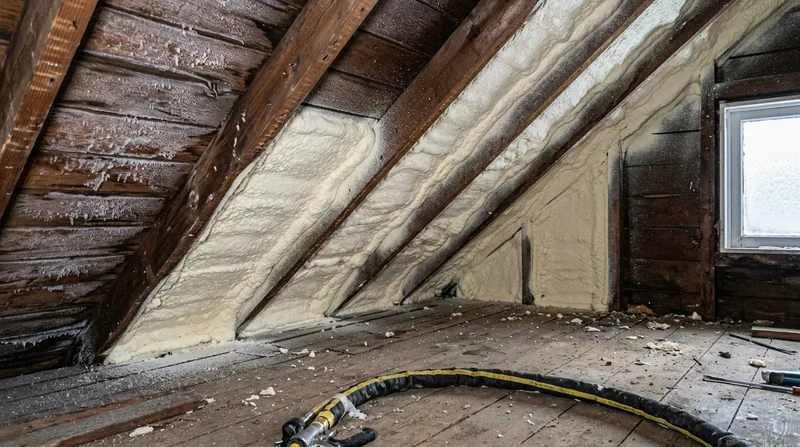




Attic spray foam insulation in South Bend stops the heat loss that drives ice dams every winter and keeps energy bills from climbing through the long heating season. South Bend's older neighborhoods, built in the early 1900s with balloon-framed walls and open cavities, sit directly above basements that run cold for months. The St. Joseph River valley amplifies lake-effect snow loads, and when warm air leaks through an uninsulated attic, it melts snow on the roof deck that refreezes at the eaves, cracking shingles and backing water into the soffit. Sealed-roof-deck foam stops that cycle cold. Postwar ranches in Mishawaka and Granger still carry 1950s insulation that has settled, leaving gaps at top plates and penetrations where air streams straight into the attic. We seal the attic floor and spray closed or open cell foam along the roof deck to lock in heat and stop the moisture migration that drives the dew point into wall cavities during the sustained cold of climate zone 5A.
Why Attic Insulation Fails in South Bend's Cold Climate
South Bend sits in IECC climate zone 5A, cold and humid, where the heating season runs long and hard. Moisture moves outward from the warm living space toward the cold outdoors nearly year-round, driving the dew point deep into wall cavities and attic framing. Fiberglass batts and blown cellulose settle over time, creating voids at the top plate where warm air escapes into the attic. Once that warm air meets the cold roof deck on a January night, condensation forms, and the insulation loses its R-value. Ice dams form when the heat loss is enough to melt snow on the shingles, the water runs down to the eaves where it is still below freezing, and it refreezes into a dam that backs water up under the shingles.
- Settled fiberglass and cellulose leave gaps at the top plate and around roof penetrations where air flows freely into the attic.
- Warm air from the living space rises into the attic and melts snow on the roof deck during the day.
- Water runs to the eaves, refreezes at night, and forms an ice dam that backs water under the shingles.
- Moisture condenses on cold framing and insulation, reducing R-value and encouraging rot and mold.
- Energy bills climb because heat that should warm the house is instead warming the roof and melting snow.
Spray foam seals the attic floor and roof deck, stopping warm air from reaching the cold shingles and stopping the moisture migration that destroys fiberglass.
Local example: A 1920s balloon-frame home in the Colfax neighborhood of South Bend had ice dams forming every winter, with water backing into the master bedroom. The attic floor had R-19 fiberglass that had settled to R-11 in many spots. We removed the old insulation, sealed all rim joists and top plates with closed cell foam, and sprayed R-38 closed cell on the roof deck. The ice dams stopped, and the homeowner's heating bills dropped by 22 percent.
For more information on how ice dams form and what causes them, see the Massachusetts Building Code guidance on ice dams and attic ventilation, which applies to the same climate zone.
How We Seal and Insulate Your Attic in South Bend
The job starts with a walk-through to measure the attic floor, identify penetrations, check the roof framing for moisture or rot, and understand whether you want a sealed roof deck (foam sprayed on the underside of the roof sheathing) or a sealed attic floor (foam sprayed on the floor joists, with the roof left vented). Sealed roof decks are the stronger choice in South Bend because they stop the warm-air-to-cold-shingles cycle that drives ice dams. We then remove any old insulation if it is wet, contaminated, or blocking access, and we air seal all rim joists, top plates, and penetrations before spraying foam. Once the foam cures, we conduct a blower door test to confirm the seal and verify the R-value at the thickness we sprayed.
- We measure the attic floor and roof deck, identify all penetrations, and assess the framing for moisture or rot.
- We remove old insulation if it is wet, settled, or blocking the work area, hauling debris off-site.
- We air seal rim joists, top plates, and all roof penetrations with closed cell foam before the main spray.
- We spray closed or open cell foam to the specified R-value and thickness, controlling the ratio and drum temperature to ensure proper cure.
- We set a re-entry window of 24 to 48 hours and provide mechanical ventilation during cure to manage off-gassing.
- We conduct a post-cure blower door test to verify the seal and document the R-value achieved.
The entire process typically takes 2 to 4 days from estimate to completion, depending on attic size and the amount of old insulation to remove.
Example from Granger: A 1970s ranch with a 1,200 sq ft attic had 1950s-era blown cellulose that had settled to an average of R-11 in the perimeter bays. We removed the old insulation, sealed all rim joists and the band joist where the basement walls meet the rim, sprayed R-38 closed cell on the roof deck, and sealed the attic floor with open cell foam at R-19. The homeowner was able to keep the attic vented at the soffits while maintaining a sealed thermal boundary, and heating costs dropped 18 percent in the first winter.
If you are considering a simpler top-up of an existing attic where the insulation is still sound, see our open cell spray foam page for the economics of blown-in fiberglass versus foam.
Attic Insulation Methods: Sealed Roof Deck vs. Sealed Floor
| Approach | Description | Best for |
|---|---|---|
| Sealed Roof Deck (Closed Cell) | Foam sprayed on the underside of the roof sheathing, creating an unvented attic that acts as conditioned space. R-value typically R-38 to R-49. No attic ventilation required. | South Bend homes with ice dam risk, moisture problems, or where the attic will be used for storage or future conversion. Eliminates the warm-air-to-cold-shingles cycle. |
| Sealed Attic Floor (Open or Closed Cell) | Foam sprayed on the attic floor joists, with roof ventilation left intact. R-value typically R-38 to R-49. Soffit and ridge vents remain open. | Homes where the attic will remain unconditioned and ventilation is desired for moisture control. Less expensive than sealed roof deck on large attics. |
| Closed Cell Foam | Higher density (1.5 to 2.0 lb/cu ft), R-value 6.5 to 7.0 per inch. Forms a vapor barrier and resists moisture. Low permeability. | Sealed roof decks, rim and band joists, or any application where moisture control is critical. Thinner coverage needed for high R-values. |
| Open Cell Foam | Lower density (0.5 to 0.7 lb/cu ft), R-value 3.5 to 3.6 per inch. Permeable to vapor, allowing the attic to dry. Sound dampening. | Sealed attic floors where ventilation is maintained, or new construction where interior vapor control is handled by drywall and paint. |
Attic Spray Foam Insulation Cost in South Bend: What to Expect
Attic spray foam insulation typically starts at $1.50 per square foot for open cell foam on an attic floor, and rises to $2.50 to $3.50 per square foot for closed cell foam on a sealed roof deck. The final cost depends on the size of the attic, the type of foam (open or closed cell), the target R-value, whether old insulation needs to be removed, the accessibility of the roof framing, and the complexity of air sealing around penetrations and rim joists. A typical 1,500 sq ft attic floor sealed with open cell foam at R-38 runs $2,250 to $3,000. A sealed roof deck on the same footprint with closed cell foam at R-38 to R-49 runs $3,750 to $5,250. If the attic has settled fiberglass or cellulose that must be removed, add $0.50 to $1.00 per square foot for the labor and disposal. Getting two or three estimates from contractors who provide written specifications including R-value, foam type, thickness in inches, and coverage area is the only way to compare apples to apples.
For a detailed breakdown of pricing and what drives the cost up or down, visit our full pricing page. We provide written estimates with R-value and thickness specs so you know exactly what you are paying for.
Attic Spray Foam Insulation Near Me: What South Bend Homeowners Should Know When Hiring
Spray foam insulation is a high-skill trade, and the difference between a careful installation and a careless one shows up in the smell, the cure time, the air seal, and the longevity of the foam. When you call a contractor, ask for a written estimate that includes the foam type (open or closed cell), the R-value per inch, the target thickness in inches, the total board feet, and the total square footage of coverage. Ask whether mechanical ventilation will be used during cure and what the re-entry window will be. Verify that the contractor carries general liability insurance and can provide a certificate of insurance naming your address. Ask for references from three recent jobs in South Bend and call them. Do not accept an estimate with no R-value and no thickness, no insurance verification, or a price far below market with no inspection. If the attic has a roof leak or standing water, the contractor should refuse to spray until the moisture is fixed. Many older homes in South Bend, Mishawaka, and Notre Dame have municipal building codes that govern attic ventilation and ignition barriers for foam, so confirm with your local building department whether a permit is required before you book the work. If you live in a master-planned community with an HOA, check the architectural rules for any restrictions on exterior work, though insulation inside the attic is rarely regulated. Call us at (574) 406-8438 for a free estimate with no obligation, and we will walk you through what applies at your address.
For more guidance on what to look for in any spray foam contractor, visit our contact page to request a free estimate and ask any questions about the process.
Attic Spray Foam Insulation in South Bend: Pricing Guide
| Service | Price | Details |
|---|---|---|
| Open Cell Attic Floor Insulation | Starting at $1.50/sq ft | Sealed attic floor with open cell foam at R-38, includes air sealing of rim joists and top plate penetrations |
| Closed Cell Sealed Roof Deck | Starting at $2.50/sq ft | Closed cell foam sprayed on roof underside at R-38 to R-49, stops ice dams and eliminates attic ventilation |
| Insulation Removal and Replacement | Starting at $0.75/sq ft removal | Labor and haul-off of settled fiberglass or cellulose, plus disposal fee, before new foam is sprayed |
| Air Sealing and Rim Joist Foam | Starting at $1.00/sq ft | Closed cell foam on rim joists, band joists, and attic floor penetrations to seal the thermal boundary |
| Complete Attic Retrofit (1,500 sq ft typical) | From $2,250 to $5,250 | Removal of old insulation, air sealing, and foam spray to R-38 or R-49 depending on open or closed cell choice |
| Estimate and Blower Door Test | Free estimate, $300 blower door test | Written estimate with R-value and thickness specs included at no charge, blower door testing available to verify the air seal |
Indicative pricing, the exact cost depends on square footage, finish, and site access. Free personalized estimate within 24h at (574) 406-8438.


