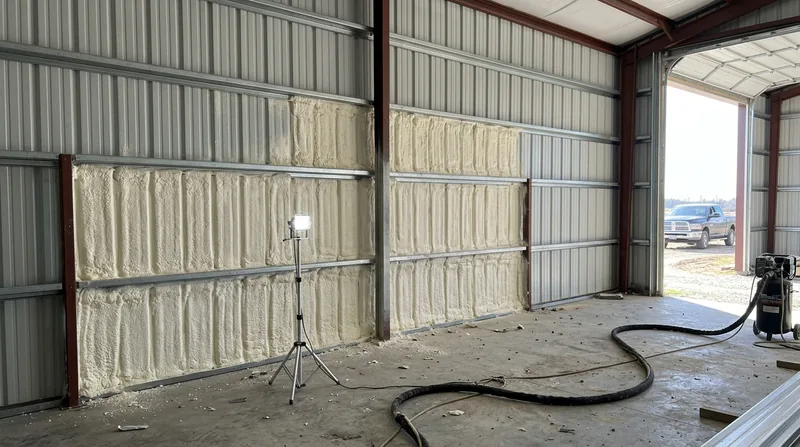




Metal Building & Barndominium Spray Foam in South Bend solves a problem unique to steel-frame structures in cold, humid climates: condensation. When summer air meets cool steel panels, moisture collects inside the building envelope, rotting insulation, rusting fasteners, and breeding mold. Spray foam bonded directly to the steel creates an unbroken thermal and moisture barrier that stops condensation before it starts. South Bend sits in IECC climate zone 5A, where the St. Joseph River valley and lake-effect snow from Lake Michigan drive sustained cold from November through March, and the transition seasons bring rapid temperature swings between day and night. Metal buildings, pole barns, and barndominiums across St. Joseph County and Elkhart County face this challenge every year. We have been serving South Bend and the surrounding area since 2011, and metal building insulation is one of our core applications because the physics is straightforward and the result is measurable.
Why Metal Building Condensation Matters in South Bend
Metal buildings in South Bend conduct temperature faster than any other building material. A steel panel at 35 degrees Fahrenheit on a winter morning will pull moisture from indoor air, especially in agricultural or equestrian barns where humidity runs high from animals, hay, and equipment storage. Without a thermal break between the steel and the interior, that dew point is reached right at the metal surface. Fiberglass batts or blown insulation hung below the purlins leave air gaps and do not stop the condensation cycle, because the steel itself remains cold and exposed to humid air.
- Condensation drips onto stored goods, equipment, and animal bedding, causing rot, rust, and disease.
- Moisture wicks into fiberglass insulation, destroying its R-value and promoting mold growth on the underside of panels.
- Steel fasteners and trim corrode where water pools, weakening the structural integrity of the building over time.
- Spray foam bonded to the steel eliminates the gap where condensation forms and creates a complete thermal barrier.
This is why closed cell spray foam is the industry standard for metal buildings in cold climates. It adheres directly to steel, has a high R-value per inch, and cures to a moisture barrier that prevents water vapor from moving through the insulation layer.
Key info: A 40-foot x 60-foot pole barn in Granger or Osceola with 2 inches of closed cell spray foam on the roof deck will maintain an interior surface temperature 15 to 20 degrees warmer than bare steel on a 20-degree January night, stopping condensation entirely and keeping stored hay, equipment, and animals in a dry environment.
For more information on the properties and performance of closed cell foam, visit our closed cell spray foam insulation page.
How We Insulate Metal Buildings and Barndominiums in South Bend
The process begins with a site inspection to assess the roof deck, wall panels, and any existing insulation or moisture damage. We identify the condensation risk zones, measure the building dimensions, and determine whether the job calls for a full spray or a targeted application to critical areas such as the roof deck and rim joist. For new construction, we coordinate with the builder or general contractor to spray during the framing stage, before drywall or interior finishes are installed. For existing buildings, we may need to remove fiberglass or other failed insulation before spraying, and we always verify that the substrate is clean and dry.
- We inspect the building envelope and document any moisture damage, rust, or existing insulation that must be removed first.
- We spray closed cell foam at the specified thickness (typically 1.5 to 3 inches for condensation control) directly onto the steel roof deck and wall panels.
- We maintain proper drum temperature and spray ratio throughout the job to ensure the foam cures to full density and adhesion.
- We provide mechanical ventilation during the cure period (24 to 48 hours) and establish a clear re-entry window before the building is occupied.
- We seal all rim joists, band joists, and penetrations with foam or air sealing caulk to eliminate thermal bridging and air leakage.
The entire process is designed to create a continuous, unbroken thermal barrier that stops heat loss in winter and condensation year-round.
Example: A 3,000-square-foot barndominium in North Liberty with a sealed roof deck and 2 inches of closed cell foam typically takes 2 to 3 days from substrate preparation through cure time. The homeowner can move in after the re-entry window closes, with a fully insulated and condensation-proof building envelope.
Metal Building Spray Foam Methods and Materials
| Approach | Description | Best For |
|---|---|---|
| Full Roof Deck Spray | Closed cell foam applied to the entire interior roof surface, typically 1.5 to 3 inches thick, creating a sealed and insulated ceiling. | New construction and existing buildings where condensation risk is high and interior finish quality matters. |
| Rim and Band Joist Sealing | Foam applied to the perimeter band joist and rim area where the building frame meets the concrete foundation, stopping thermal bridging and air infiltration. | All metal buildings on concrete slabs or crawl spaces; often combined with roof deck spray for complete envelope control. |
| Wall Panel Insulation | Closed cell foam sprayed directly onto vertical wall panels to stop condensation on the steel and provide thermal resistance on the side walls. | Barndominiums and residential metal buildings where interior wall temperature and comfort are important. |
| Removal and Replacement | We remove failed fiberglass, mineral wool, or previous foam installations and spray new closed cell foam to restore the thermal barrier and moisture control. | Existing pole barns and agricultural buildings with deteriorated insulation or active condensation problems. |
Metal Building & Barndominium Spray Foam Cost in South Bend: What to Expect
Pricing for metal building spray foam in South Bend starts at $1.75 per square foot for a standard closed cell application on a roof deck or wall surface. The final cost depends on the building size, the thickness of foam required (typically 1.5 to 3 inches), the condition of the existing substrate, and whether insulation removal is needed first. A 3,000-square-foot metal building roof deck in South Bend, Mishawaka, or Granger with 2 inches of closed cell foam will fall into the mid-range of that scale. Access to the building, the need for scaffolding, and the complexity of the roof geometry can also move the price up.
We always provide a written estimate that specifies the R-value, foam thickness, square footage, and total cost before we begin work. This estimate is free, and there is no obligation to book. Call us at (574) 406-8438 or visit our pricing page for a detailed breakdown of how we calculate costs.
The best way to understand your project cost is to get 2 or 3 estimates from different contractors. Be wary of any estimate that does not specify R-value and thickness, quotes a price far below market, or promises immediate re-entry. Those are signs of poor workmanship or shortcuts that will cost you later in mold, condensation, or foam failure.
What to Look for When Hiring a Spray Foam Contractor Near South Bend
Spray foam insulation is a specialized trade, and the quality of the installation is everything. A poorly mixed ratio, inadequate drum temperature, or rushing the cure window will result in foam that does not bond properly, does not reach full R-value, and may off-gas or shrink over time. When you are evaluating contractors near South Bend, Elkhart, or Notre Dame, ask these questions to verify that you are working with a professional shop.
- Ask for a written estimate that includes R-value per inch, thickness in inches, total square footage, and the foam type (closed cell or open cell).
- Verify that the contractor is fully insured and ask for a certificate of insurance naming your property as an additional insured during the work.
- Ask how they handle mechanical ventilation during cure and what re-entry window they recommend before the building is occupied.
- Request references from recent metal building or barndominium projects in South Bend or the surrounding area and call at least two.
- Confirm that the contractor understands local permitting and building code requirements for thermal barriers and ignition barriers, and that they will help you navigate what applies at your address.
- Check whether the building has any HOA architectural restrictions on exterior work or metal building modifications, and ensure the contractor is aware of those rules.
We are fully insured, and we have been installing spray foam in South Bend and the surrounding area since 2011. We provide written estimates with R-value and thickness specifications, we maintain proper spray technique and cure protocols, and we stand behind our work with a one-year workmanship warranty. Contact us for a free estimate and to discuss your metal building or barndominium insulation project.
Metal Building & Barndominium Spray Foam in South Bend: Pricing Guide
| Service | Price | Details |
|---|---|---|
| Roof Deck Spray (Closed Cell) | Starting at $1.75/sq ft | Full interior roof deck coverage at 1.5 to 3 inches, condensation control and thermal barrier included, price varies by thickness and building access |
| Wall Panel Insulation | Starting at $1.75/sq ft | Vertical steel panels sprayed with closed cell foam, typical application 1.5 to 2 inches, price depends on panel height and surface condition |
| Rim and Band Joist Sealing | Starting at $800 | Perimeter band joist and rim area sealed with foam to eliminate thermal bridging, linear footage and building perimeter determine final cost |
| Insulation Removal and Replacement | On estimate | Removal cost depends on existing insulation type, volume, and disposal; replacement foam cost calculated separately after substrate is clean and dry |
| Travel and Estimate | Included in South Bend area | No separate call-out fee or mileage charge for service areas; free written estimate with R-value and thickness specifications provided within 24 hours |
Indicative pricing, the exact cost depends on square footage, finish, and site access. Free personalized estimate within 24h at (574) 406-8438.


