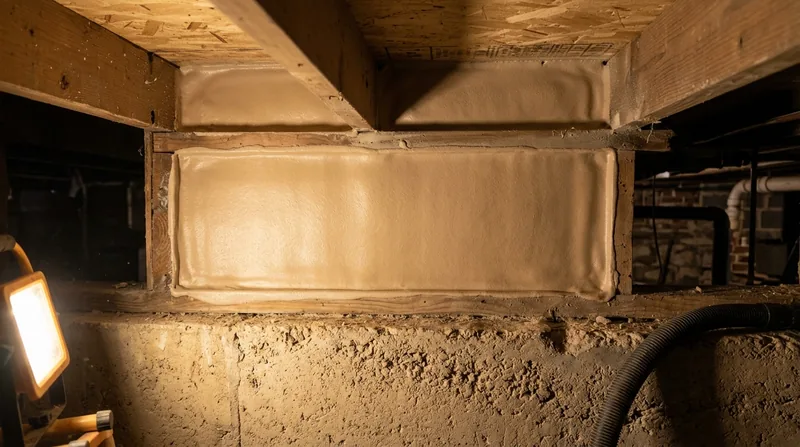




Closed cell spray foam insulation in South Bend is the right choice for basements and rim joists that stay damp through the long heating season, and for old balloon-framed walls near Notre Dame where air leaks straight through to the outside. South Bend's climate is IECC zone 5A, cold and humid, with sustained subfreezing temperatures from November through March and lake-effect snow pushing down from Lake Michigan. Your basement rim joist is the thermal weak point in nearly every home here, from South Bend into Elkhart County. Closed cell foam holds up in that damp environment, resists moisture vapor, and adds structural rigidity to wood that has already taken decades of seasonal movement. We install closed cell spray foam that seals and insulates in one pass, with no settling, no gaps at top plates, and no air leakage through old wall cavities.
Why Closed Cell Spray Foam Matters in South Bend's Damp Basements and Old Walls
South Bend's older neighborhoods are full of frame homes built in the early 1900s with balloon-framed walls and open cavities that bleed heat straight through to the outside. The postwar ranches around Mishawaka carry 1950s and 1960s insulation that has settled and left gaps at top plates and penetrations. Every home here sits over a full basement, and those basements run cold and damp through the long heating season, especially around the rim and band joists where the foundation meets the rim board. Moisture moves outward from your heated living space toward the cold outdoors most of the year, driving the dew point inside wall cavities and across the rim joist. Closed cell foam stops that air movement and resists moisture vapor better than fiberglass or open cell foam.
- Closed cell foam reaches an R-value of 6.0 to 6.5 per inch, so a 2-inch application on a rim joist delivers R-12 to R-13 in a space where fiberglass would settle and leave gaps.
- The material cures to a rigid, structural foam that does not sag, does not settle, and does not separate from the rim board over decades of basement humidity and temperature swings.
- Closed cell foam resists moisture vapor transmission better than open cell foam, which is critical in a damp basement where the rim joist absorbs seasonal moisture from the foundation.
- The foam air-seals the entire rim joist, band board, and top plates in old balloon-framed walls, stopping the convective loop that pulls cold air through the wall cavity into your basement and living space.
- In South Bend's sustained cold season, a sealed rim joist with closed cell foam cuts the temperature drop from the living space to the basement by 10 to 15 degrees Fahrenheit.
The result is a warmer basement, lower heating bills, and no settling or moisture problems down the road.
Key info: South Bend and Notre Dame sit in zone 5A with sustained subfreezing temperatures and high humidity. A rim joist left uninsulated loses more heat per square foot than any other part of your home. Closed cell foam is the only insulation that does not settle, does not allow air to move through it, and handles the damp environment without degradation.
How We Install Closed Cell Spray Foam in South Bend: The Process and the Details
Closed cell spray foam installation starts with a thorough inspection of the rim joist, basement walls, or wall cavities you want to seal. We identify where moisture is present, where air is moving, and what substrate needs to be dry before we spray. If the rim joist or rim board is wet or has active moisture, we do not spray. We fix the moisture first or we walk away. Once the area is dry and prepped, we spray the closed cell foam in thin, controlled passes, typically 1 to 1.5 inches per pass, to ensure proper chemical ratio, drum temperature, and cure time. We maintain mechanical ventilation during and after the spray to control odor and VOC off-gassing. The foam cures in 24 to 48 hours, and we provide a clear re-entry window before you use the space again. Every installation comes with a written estimate that specifies R-value, thickness, and coverage area so you know exactly what you are paying for.
- We inspect the rim joist, basement walls, or wall cavities for moisture, active leaks, or contamination before any foam is sprayed.
- We dry the substrate and seal any active water entry or air leaks from the outside before we apply foam to the inside.
- We spray closed cell foam in controlled passes, typically 1 to 1.5 inches per pass, maintaining the manufacturer drum temperature and chemical ratio throughout the job.
- We run mechanical ventilation during the spray and cure phase to control fumes and ensure proper off-gassing of VOCs.
- We provide a written estimate with R-value, thickness, and square footage so you see exactly what the job covers and what it costs.
- We give you a clear re-entry window, typically 24 to 48 hours, before the space is safe for normal use.
This process is the only way to install closed cell foam correctly in South Bend's damp climate.
Example: A Granger homeowner with a damp rim joist and settling fiberglass in the band board calls us in January. We inspect the rim, find no active leak but persistent moisture from the foundation, dry the area with temporary ventilation, then spray 2 inches of closed cell foam on the rim joist and rim board. The foam cures in 36 hours, the basement temperature rises 12 degrees, and the homeowner turns down the heat 2 degrees. The job takes one day, costs between $900 and $1,400 depending on linear feet, and comes with a one-year workmanship guarantee.
For more detail on how we approach other areas of your home, see our guide to attic spray foam insulation in South Bend and air sealing services.
| Approach | Description | Best for |
|---|---|---|
| Closed cell rim joist and band board | 2 to 3 inches of closed cell foam sprayed on the rim joist, rim board, and band board to seal and insulate the foundation perimeter. | Damp basements in South Bend, Mishawaka, and Granger where the rim joist is the primary heat loss point and fiberglass has settled or failed. |
| Closed cell wall cavity retrofit | Closed cell foam injected into existing wall cavities of balloon-framed or open-cavity walls to seal air leaks and add R-value without demolition. | Early-1900s frame homes near Notre Dame and South Bend with clapboard siding and air leaks through the wall cavity into the basement or attic. |
| Closed cell basement wall and floor rim | Full closed cell coverage of the basement rim, band, and top 3 to 4 feet of the basement wall to stop moisture vapor and air leakage from the foundation. | Finished basements in Elkhart and surrounding areas where moisture control and air sealing are critical to comfort and mold prevention. |
| Closed cell garage rim and wall | Closed cell foam on the garage rim joist and walls to prevent cold air from moving into the attached home and to reduce condensation on the garage ceiling in winter. | Attached garages in Granger, North Liberty, and Osceola where the garage rim joist is a direct path for cold air infiltration into the living space. |
| Closed cell sealed attic rim and soffit | Closed cell foam at the attic rim board and soffit to stop ice dams at the eaves where attic heat melts snow on the roof deck. | Homes near Notre Dame and South Bend where the St. Joseph River valley creates cold air pools and ice dams form each winter at the eaves. |
Closed Cell Spray Foam Insulation Cost in South Bend: What to Expect
Closed cell spray foam insulation in South Bend starts at around $1.20 per board foot for straightforward rim joist and band board applications, and can run $1.50 to $2.00 per board foot for wall cavity retrofit or sealed basement applications where access is tight or the substrate requires extra prep. A typical rim joist job on a 40-foot perimeter basement costs between $900 and $1,400, depending on the height of the rim board and the amount of prep work needed to dry the substrate and seal any active moisture entry. Wall cavity retrofit in an old balloon-framed home near Notre Dame can run $1,200 to $2,500 for a single wall or a room, depending on the number of cavities, the depth of the wall, and whether we need to remove and replace old insulation first. A sealed basement application covering the rim, band, and 3 to 4 feet of wall can range from $2,000 to $4,500, again depending on linear feet and the condition of the substrate.
The factors that move the cost are the linear footage of rim joist or wall cavity, the height and depth of the foam application, the condition of the substrate (whether it is dry or requires prep and drying), the accessibility of the area, and whether old insulation needs to be removed and disposed of first. If you have an active moisture problem or a wet substrate, we will assess that separately and may recommend a drying phase before foam is applied. We always provide a written estimate with R-value, thickness, and coverage area before any work begins. The best way to understand the real cost for your home is to get a free estimate from us, where we measure the job on site and give you a firm number with no surprises.
Closed Cell Spray Foam Insulation Near Me: What South Bend Homeowners Should Know When Hiring a Contractor
When you are looking for a closed cell spray foam insulation contractor in South Bend or nearby areas like Mishawaka, Granger, and Elkhart, the most important thing is to verify that the contractor is fully insured and can show proof of current coverage. Ask for a Certificate of Insurance naming your address as an additional insured, and call the insurance company to confirm the policy is active. Get at least two or three written estimates, and compare them on R-value, thickness, and coverage area, not just price per board foot. Any estimate that does not specify R-value and thickness is a red flag. Ask how the contractor will handle moisture if the substrate is damp, and walk away from anyone who promises to spray over a wet rim joist or active leak. Check references from recent jobs, and ask those references specifically about the smell, the re-entry timeline, and whether the contractor explained the cure process before the work started. If you live in a master-planned community with an HOA, check whether there are any architectural rules that govern exterior work or access to the foundation, though most HOAs do not restrict interior insulation work.
- Verify that any contractor you hire is fully insured with a current Certificate of Insurance that names your address as an additional insured.
- Get written estimates from at least two contractors, and compare them on R-value, thickness, and square footage, not just the price per board foot.
- Ask how the contractor will handle moisture and damp substrates, and do not hire anyone who promises to spray over wet surfaces or active leaks.
- Check references from recent jobs in South Bend and ask specifically about the smell, the cure timeline, and whether the contractor explained the process before starting.
- Confirm that the contractor will run mechanical ventilation during the spray and cure phase and provide a clear re-entry window in writing.
- Ask whether the contractor will pull any permits required by your city, and understand that permitting varies from South Bend to Granger to Elkhart, so always verify with your local building department.
A good contractor will answer all of these questions clearly and provide a written estimate with no pressure to sign on the spot. Call us at (574) 406-8438 for a free estimate and we will walk you through every detail of the process.
Closed Cell Spray Foam Insulation in South Bend: Pricing Guide
| Service | Price | Details |
|---|---|---|
| Rim joist and band board | Starting at $1.20/board ft | 2 to 3 inches of closed cell foam on rim joist, band board, and rim board; cost varies by linear feet and rim height |
| Wall cavity retrofit | Starting at $1.50/board ft | Closed cell foam injected into existing wall cavities without demolition; cost increases with cavity depth and number of walls treated |
| Basement rim and wall coverage | Starting at $1.80/board ft | Closed cell foam on rim joist, band board, and 3 to 4 feet of basement wall; cost depends on linear feet and substrate prep required |
| Moisture remediation and substrate prep | On estimate | If rim joist is damp or substrate requires drying before foam can be applied, we assess and price separately from the foam application |
| Insulation removal and disposal | On estimate | If old fiberglass, cellulose, or failed foam must be removed before closed cell can be installed, removal and haul-away priced separately |
| Estimate | Free | Response within 24 hours at (574) 406-8438, written estimate with R-value and thickness specs, no obligation to book |
Indicative pricing, the exact cost depends on square footage, finish, and site access. Free personalized estimate within 24h at (574) 406-8438.


