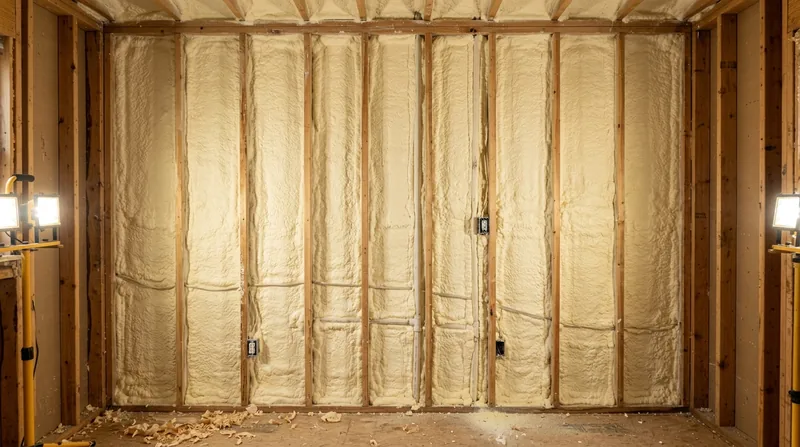




Open cell spray foam insulation in South Bend fills wall cavities and attics in homes built from the 1920s through the 1960s, sealing the gaps that decades of settling insulation and wood shrinkage have left behind. South Bend's older frame neighborhoods, built on St. Joseph River floodplain terrain with balloon-framed walls and open cavities, lose heat steadily through winter months when sustained cold pushes the dew point inward. Around Notre Dame and Mishawaka, postwar ranches with 1950s-60s fiberglass that has settled at the bottom of wall cavities sit over full basements that run cold all season long. Open cell foam expands to fill those voids, cuts drafts at top plates and penetrations, and dampens the noise that travels through thin postwar walls. Unlike closed cell, which hardens to a rigid shell and resists moisture, open cell stays slightly soft and breathable, making it the right choice for interior wall cavities where moisture needs to move through the foam rather than trap behind it. This guide explains why open cell matters in Michiana's climate zone 5A, how the work gets done, what it costs, and what to look for when hiring a spray foam contractor near you.
Why Open Cell Spray Foam Matters in South Bend's Older Neighborhoods
South Bend's housing stock tells a story of settling insulation and air leaks. Homes built before 1970 in South Bend, Mishawaka, and Granger rarely have insulation in the wall cavities at all, or the fiberglass that was poured in decades ago has compacted to the bottom, leaving 3 to 4 feet of empty cavity at the top of every outside wall. In climate zone 5A, with winter temperatures that stay below freezing for months and lake-effect snow off Michigan, those empty or half-filled cavities bleed heat directly through the frame and out through clapboard siding. Open cell spray foam seals those voids completely, fills around electrical boxes and rim plates that are impossible to insulate with traditional batts, and cuts the convection currents that move warm air up and out through the attic.
- Open cell expands to roughly 3.5 pounds per cubic foot, filling every corner of a wall cavity without voids or gaps.
- The foam is breathable, allowing moisture vapor to move through it rather than trap behind it, which prevents condensation buildup in cold wall cavities.
- Sound-dampening properties reduce noise transmission through thin postwar walls, a common complaint in Mishawaka ranches with shared walls or homes near busy streets.
- Installation requires no demolition of drywall, making it the retrofit option for existing walls when full cavity access is not available.
- Open cell typically delivers an R-value of 3.5 to 3.8 per inch, lower than closed cell but sufficient for interior wall cavities in zone 5A when combined with exterior air barriers.
When fiberglass has settled or never existed, open cell spray foam is the fastest way to restore insulation performance and stop the draft that homeowners feel at baseboards and around outlets on the coldest days.
Local example: A 1950s ranch in Mishawaka with balloon-framed walls and settled fiberglass in the outer cavities loses 2 to 3 degrees per hour on a 20-degree night. Open cell foam injected into those cavities without drywall removal seals the convection path and cuts that heat loss by 40 to 60 percent in the affected zone.
For more on how spray foam seals older homes, see our guide to wall and injection foam insulation in South Bend.
How We Install Open Cell Spray Foam in South Bend Attics and Walls
Open cell spray foam installation is a controlled process that requires the right equipment, material ratio, and ventilation. We assess the cavity size and shape, verify that the substrate is dry and sound, and spray the foam in thin passes rather than one thick application. Each pass is typically 1 to 2 inches, allowing the foam to expand fully and cure evenly. During application, we run mechanical ventilation to move the isocyanate vapors out of the space, and we establish a re-entry window of 24 to 48 hours before the space is occupied again. The foam continues to cure for several weeks, reaching full strength and final R-value only after complete chemical cross-linking.
- We inspect the cavity for moisture, active leaks, or contamination, and we do not spray over wet or damaged substrate.
- Material is heated to manufacturer specification and mixed at the correct ratio, ensuring proper expansion and foam density.
- We spray in thin, overlapping passes perpendicular to the cavity, building thickness gradually rather than attempting one thick application.
- Mechanical ventilation runs continuously during application and for 24 hours after, removing isocyanate vapor and allowing the space to off-gas safely.
- We document the thickness and coverage with photographs and provide a written record of the R-value and board feet applied.
- Re-entry is not permitted until mechanical ventilation has completed and the homeowner has been given a clear timeline.
This controlled approach prevents the common mistakes that lead to odor complaints, incomplete cure, and foam that shrinks or fails to bond properly.
Practical example: A wall cavity in a South Bend frame home is 14.5 inches deep and 8 feet tall. We spray open cell in four passes, each 1.5 inches, for a total of 6 inches of foam and an R-value of approximately 21. The job takes 3 to 4 hours of active spray time, plus 24 hours of mechanical ventilation. Re-entry is permitted the following day once the foam has cured and off-gassing is complete.
For more on how we handle attic insulation work, see attic spray foam insulation in South Bend.
| Approach | Description | Best for |
|---|---|---|
| Open Cell Wall Cavity Fill | Spray foam injected into existing wall cavities without drywall removal, typically 4 to 6 inches thick. | Retrofit of older homes where interior cavity access is available or where selective drywall removal is acceptable. |
| Open Cell Attic Insulation | Spray foam applied to attic floor joists or sealed roof deck, creating a continuous air barrier and thermal layer. | Attics with settled or missing insulation, or where air sealing is the priority and R-value is secondary. |
| Open Cell Sound Dampening | Spray foam applied to interior walls or between floors, providing both insulation and acoustic absorption. | Postwar ranches and multistory homes where noise transmission is a concern and interior walls need upgrading. |
| Open Cell Over Existing Insulation | Thin layer of spray foam applied over settled or low-R fiberglass, adding R-value and sealing gaps. | Top-up of attics where complete removal is not cost-effective and the existing insulation is sound but insufficient. |
Open Cell Spray Foam Insulation Cost in South Bend: What to Expect
Open cell spray foam costs vary by project scope, cavity size, and access. Starting at $0.55 per board foot, a typical wall cavity fill or attic top-up runs between $800 and $2,200 depending on the square footage and thickness required. A full attic in a Mishawaka ranch of 1,200 square feet, sprayed to 4 inches, typically costs $1,500 to $2,800. Wall cavity fills in a single room cost less, typically $600 to $1,200. The price per board foot can move up if access is difficult, if the substrate requires preparation, or if the cavity is unusually deep or oddly shaped. Travel within South Bend and surrounding areas is included in the estimate, with no separate mileage charge.
Factors that affect the final cost include cavity depth and width, whether drywall removal is needed, the condition of the substrate, the R-value target, and the total board feet of foam. We provide a written estimate that specifies the thickness in inches, the R-value, and the board feet to be applied. This transparency allows you to compare estimates fairly and understand exactly what you are paying for.
The cheapest estimate is not always the best. Contractors who quote a price without specifying thickness, R-value, and board feet are cutting corners, and their work often fails to cure properly, smells for weeks, or shrinks away from the cavity edges. A detailed estimate with specifications is the mark of a professional shop. For a full breakdown of pricing across all our services, see our pricing page.
What to Look for When Hiring a Spray Foam Insulation Contractor Near South Bend
Hiring the right spray foam contractor matters because the work is invisible once cured, and mistakes are expensive to fix. A contractor who sprays foam improperly, fails to ventilate during cure, or promises immediate re-entry is setting you up for odor complaints, incomplete cure, and foam that shrinks or debonds. When evaluating contractors near South Bend, ask for detailed estimates that include R-value and thickness, verify that they carry full insurance coverage, ask for references from recent jobs, and understand what permits apply at your address. Many homeowners assume that spray foam work requires a permit, but the truth depends on your specific city and whether the work involves attic ventilation changes. We help you navigate what applies locally, but the final determination rests with your building department.
- Verify that the contractor carries full insurance coverage and can provide a certificate on request.
- Ask for a written estimate that specifies the thickness in inches, the R-value per inch, and the total board feet to be applied.
- Request references from at least two jobs completed in the past 12 months and contact those homeowners to ask about cure time, odor, and long-term performance.
- Understand whether your city requires a permit for the work you are planning, and confirm that the contractor will help you obtain it if needed.
- Ask about the mechanical ventilation plan during cure and the re-entry window, which should be 24 to 48 hours for open cell foam.
- Confirm that the contractor will not spray over wet substrate, and ask what happens if moisture or mold is discovered during the inspection.
A local contractor with a South Bend address and a track record in your neighborhood is a safer bet than a rig-and-run crew from out of state or a national franchise with no local accountability. For a free estimate and to discuss your specific project, contact us at (574) 406-8438. We respond within 24 hours and provide a detailed written estimate at no obligation.
Open Cell Spray Foam Insulation in South Bend: Pricing Guide
| Service | Price | Details |
|---|---|---|
| Open Cell Wall Cavity Fill | Starting at $0.55/board ft | Typical wall cavity retrofit costs $600 to $1,200 depending on cavity depth and total square footage of walls |
| Open Cell Attic Insulation | Starting at $0.55/board ft | Full attic in 1,200 sq ft Mishawaka ranch typically $1,500 to $2,800 for 4 inches of foam coverage |
| Open Cell Sound Dampening (Interior Walls) | Starting at $0.55/board ft | Single-room application in postwar ranch typically $700 to $1,400 depending on wall surface area and access |
| Complex or Large-Scale Job | On estimate | Unusual cavity shapes, difficult access, substrate prep, or multi-story projects require on-site inspection before pricing |
| Travel | Included | No separate mileage fee or travel charge within South Bend and surrounding service areas |
| Free Estimate | No charge | Written estimate with R-value and thickness specifications, response within 24 hours at (574) 406-8438 |
Indicative pricing, the exact cost depends on square footage, finish, and site access. Free personalized estimate within 24h at (574) 406-8438.


