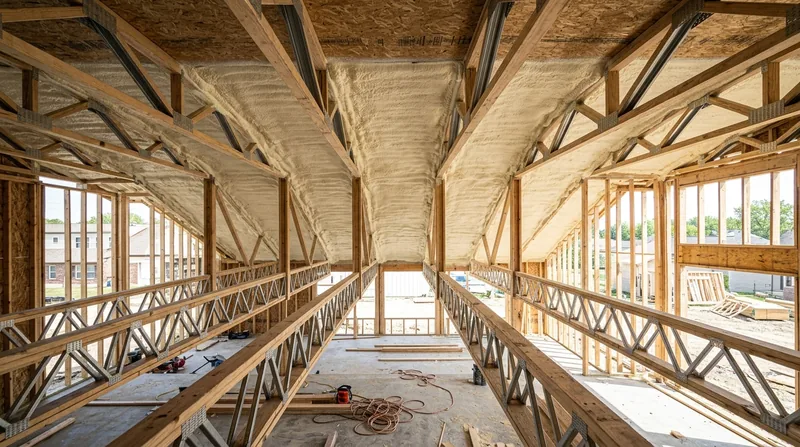




Commercial & New Construction Spray Foam in South Bend insulates new builds and renovation shells at the scale and speed that commercial timelines demand. South Bend's industrial corridors, office parks, and mixed-use developments sit in IECC climate zone 5A, where heating loads run high from October through April and the cost of thermal leakage compounds across large envelope areas. Whether you are framing a metal building in Mishawaka, closing a roof deck on a new warehouse near Granger, or sealing rim joists on a multi-unit residential shell, spray foam applied during construction avoids the retrofit constraints of occupied space and delivers continuous insulation with air sealing in a single pass. We spray attics, walls, roof decks, and basements from the inside during the framing and sheathing phase, when access is open and the crew can work without disturbing tenants or residents. Read on to understand why this timing matters, what the process looks like, and how to verify a contractor's work on your project.
Why Commercial Spray Foam Insulation Matters in South Bend's Cold Climate
South Bend winters push sustained heating demand from November through March, with lake-effect snow and wind chill that drives moisture outward through wall cavities and attic decks. A commercial building with a vented attic or an uninsulated rim joist bleeds heat continuously, and the cost compounds across every heated square foot. Spray foam eliminates thermal bridging at studs, band joists, and roof penetrations that fiberglass and mineral wool cannot seal. In a new construction frame, applying foam during the open-wall phase means no demolition, no occupied-space restrictions, and faster project completion because the envelope closes tight before drywall or exterior cladding goes up.
- Spray foam creates an air barrier that stops infiltration at studs, headers, and rim joists in a single application.
- Continuous insulation eliminates thermal breaks that reduce fiberglass R-value in cold climates.
- Foam applied during framing avoids the cost and disruption of retrofitting an occupied building.
- Roof deck insulation prevents ice dams and condensation on metal decking in South Bend's freeze-thaw cycle.
- Commercial projects benefit from predictable scheduling because foam cures in 24 to 48 hours, clearing the path for the next trade.
These advantages compound on large buildings where energy waste translates to measurable operating costs year after year.
Key info: South Bend's postwar commercial stock and newer warehouse parks around Mishawaka are built to older thermal standards. A new construction project insulated with spray foam from day one avoids the retrofit burden that owners of 1970s and 1980s buildings face.
For more on how insulation impacts long-term building performance, visit our closed cell spray foam page to understand the technical specifications that govern commercial-grade insulation.
How We Install Commercial Spray Foam During New Construction and Renovation
Commercial spray foam installation begins during the framing phase, after the structural frame is up but before sheathing or cladding closes the envelope. We assess the roof deck, wall cavities, rim joists, and any mechanical chases to determine whether closed-cell or open-cell foam is appropriate for the use case. Closed-cell foam is standard for roof decks and rim joists because it resists moisture and provides structural rigidity. Open-cell foam is sometimes used in interior walls where sound dampening matters and moisture risk is low. We establish mechanical ventilation during the spray and cure phases to manage off-gassing, and we confirm the re-entry window (typically 24 to 48 hours) with the general contractor before moving to the next trade.
- We conduct an on-site review of the frame, roof deck, and mechanical plans to specify foam type and thickness.
- Foam is applied in controlled passes to achieve the specified R-value and thickness without over-application.
- We maintain drum temperature and mix ratio to manufacturer spec and operate mechanical ventilation during cure.
- Thickness and R-value are documented on site and included in the project record.
- We coordinate with the general contractor on scheduling and access to avoid delays to subsequent trades.
This approach keeps the project on schedule and ensures the insulation is installed to spec before the building is sealed.
Example: A new light industrial building in Osceola requires a sealed roof deck over a climate-controlled warehouse. We spray closed-cell foam at 2 inches (R-14) on the metal deck during framing, before the roof membrane is installed. Applied to the underside of the roof deck, the foam seals the building envelope and sharply cuts condensation risk.
For detailed information on air sealing practices that complement spray foam, see our air sealing service page.
Commercial Spray Foam Insulation Methods and Approaches
| Approach | Description | Best for |
|---|---|---|
| Closed-Cell Roof Deck | High-density foam (1.5 to 2 lb/cu ft) applied 1.5 to 3 inches on metal or wood decking to create a continuous thermal and moisture barrier. | Metal buildings, warehouses, and sealed attics where condensation control and structural support are priorities. |
| Closed-Cell Wall Cavity | Foam fills stud cavities and seals penetrations, rim joists, and band joists to eliminate thermal bridging and air leakage. | New construction walls, basement rim joists, and crawl space headers where airtightness and R-value density matter. |
| Open-Cell Interior Walls | Low-density foam (0.5 to 0.7 lb/cu ft) applied to interior walls for sound absorption and moderate R-value at lower cost. | Multi-unit residential buildings, office partitions, and sound-sensitive spaces where vapor permeability is acceptable. |
| Rim Joist and Band Joist Sealing | Closed-cell foam applied to the perimeter rim and band joists to seal the basement-to-wall junction and stop infiltration. | New construction basements and crawl spaces, and retrofit projects where the rim is exposed and accessible. |
Commercial & New Construction Spray Foam Cost in South Bend: What to Expect
Commercial spray foam pricing depends on the scope of the project, the foam type selected, and the thickness required to meet code and performance targets. A free commercial estimate is the starting point. We visit the site, measure the roof deck, wall cavities, and rim joists, review the plans, and provide a written estimate that specifies R-value, thickness, and the total board feet of foam. Cost factors include building size, roof pitch and complexity, access for equipment, whether the substrate is clean and dry, and the timeline for the project. Larger buildings and faster timelines sometimes increase crew size and mobilization cost. Getting two or three estimates from different contractors is smart practice because pricing varies based on equipment, crew availability, and the contractor's experience with commercial work.
- Roof deck insulation on a 10,000 sq ft metal building typically starts at a range of $1.50 to $2.50 per board foot for closed-cell foam.
- Rim joist and band joist sealing on a large basement or crawl space runs $3 to $6 per linear foot depending on joist depth and accessibility.
- Wall cavity fill on new construction framing is priced per board foot once the wall area and cavity depth are measured on site.
- Travel and mobilization are included in the estimate for projects within South Bend and surrounding areas.
Realistic estimates include labor, equipment, and material. Pricing that is far below market often signals missing elements like mechanical ventilation during cure or no written thickness specification. For a full overview of our pricing structure, visit our pricing page.
What to Look for When Hiring a Spray Foam Contractor Near South Bend
Hiring a spray foam contractor for a commercial project requires verification of insurance, understanding of local permitting, and confirmation that the contractor has experience with commercial-scale work. Before you sign a contract, ask the contractor to provide proof of general liability and property damage insurance, and verify that the policy is current and covers spray foam application. Request references from completed commercial projects in the South Bend area and follow up with at least two of them. Confirm that the contractor understands South Bend's building code and any HOA or architectural rules that may apply to exterior work. Ask for a written estimate that includes R-value, thickness in inches, and total board feet, and verify that the contractor will provide documentation of the completed work for your project record. Indiana law requires utility locates before any excavation, but spray foam work rarely involves digging; clarify this with the contractor so expectations are clear. Finally, call the South Bend Building Department or your city's building office to confirm what permits and inspections apply to your project and whether the contractor is required to pull them or assist you in navigating the process.
For a free estimate and to discuss your commercial project, contact us at (574) 406-8438 or visit our contact page.
Commercial & New Construction Spray Foam in South Bend: Pricing Guide
| Service | Price | Details |
|---|---|---|
| Free Commercial Estimate | Free | On-site review of roof deck, walls, rim joists, and mechanical plans with written R-value and thickness specification |
| Closed-Cell Roof Deck Insulation | Starting at $1.50/board foot | Metal or wood decking, 1.5 to 3 inches, includes labor, material, and mechanical ventilation during cure |
| Rim Joist and Band Joist Sealing | Starting at $3/linear foot | Basement or crawl space perimeter, depth-dependent, includes access assessment and written documentation |
| Wall Cavity Fill (New Construction) | On estimate | Priced per board foot after on-site measurement of stud depth, wall area, and cavity configuration |
| Travel and Mobilization | Included | South Bend, Mishawaka, Granger, and surrounding service areas, no separate mileage or call-out fee |
| Estimate Response | Within 24 hours | Call (574) 406-8438 to schedule, no obligation to book, written estimate provided on site |
Indicative pricing, the exact cost depends on square footage, finish, and site access. Free personalized estimate within 24h at (574) 406-8438.


