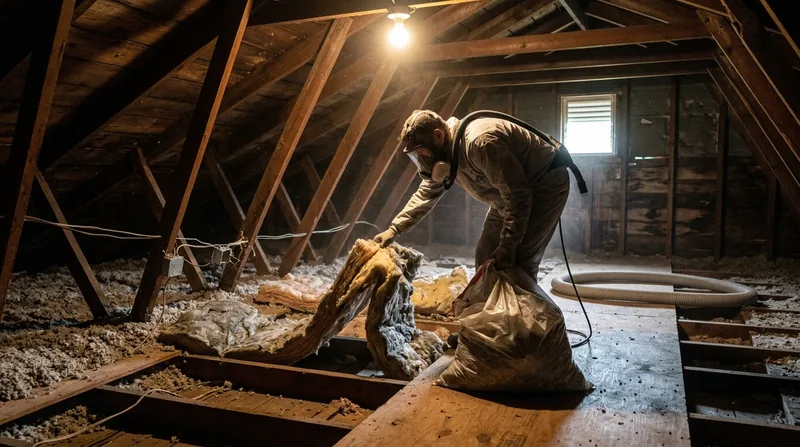




Mishawaka's postwar ranches and South Bend's early 1900s balloon-frame homes often carry insulation installed decades ago that has settled, compacted, or failed outright, leaving gaps at top plates, rim joists, and wall cavities that bleed heat straight through the winter. Insulation Removal in South Bend is the essential first step before new spray foam can seal those leaks properly. Old fiberglass, blown cellulose, or mineral wool that has settled or become contaminated must come out so the substrate is clean, dry, and ready for a new thermal and air barrier. We remove the failed material completely, haul it away, and prepare the cavity for spray foam that will actually adhere and perform. This is not a cosmetic step, it is the foundation of any retrofit that will hold for decades in climate zone 5A.
Why Insulation Removal Matters in South Bend's Older Housing Stock
South Bend and surrounding areas sit in the path of lake-effect snow and sustained winter cold that drives moisture outward from heated living space toward the cold outdoors. When old insulation settles or compacts, it stops performing, but worse, it traps moisture and creates a pathway for air to bypass it entirely. A settled attic in a Notre Dame or Granger home may have lost 30 to 40 percent of its R-value simply because the material compressed over twenty or thirty years. Removing that failed layer and replacing it with closed or open cell spray foam closes those air paths and restores the thermal boundary.
- Old blown-in insulation settles unevenly, leaving voids at top plates and around penetrations where heat escapes all winter.
- Fiberglass batts installed in the 1960s and 1970s often contain asbestos in the kraft facing or binder, requiring careful removal and disposal.
- Contaminated or moisture-damaged insulation loses its thermal resistance and must be replaced, not topped up with new material.
- Removing old insulation allows us to seal air leaks and add mechanical ventilation during spray foam cure, preventing odor complaints and off-gassing.
- A clean substrate ensures spray foam bonds properly and achieves the thickness and R-value specified in your estimate.
Proper removal is not a cost to grudge, it is the investment that makes the new system work.
Key info: Indiana's building code governs how old insulation must be handled. Contact your local building department or the Indiana Department of Natural Resources to verify what applies at your address in South Bend, Mishawaka, or Granger. Some older insulation may contain materials that trigger special handling.
How We Remove Old Insulation and Prepare Your Space
Removal is a step-by-step process that starts with containment and ends with a clean, ready substrate. We set up plastic barriers and mechanical ventilation to control dust, remove the old material systematically, and dispose of it according to local and state regulations. Once the cavity is empty, we inspect for moisture, air leaks, and any damage that must be addressed before foam is applied. This is also the moment we verify that rim joists, band joists, and top plates are accessible and ready for sealing. A thorough removal job takes a day or two depending on attic size and material type, and it is the quiet precondition of every successful retrofit.
- We contain the work area with plastic sheeting and set up negative air pressure to keep dust out of living spaces.
- Old insulation is removed by hand or with pneumatic equipment, depending on type and condition, and loaded into bags for disposal.
- We inspect the framing, decking, and rim joists for moisture, rot, or air leaks that must be corrected before new insulation is installed.
- Any gaps in the rim joist band or top plate are sealed with foam or caulk before spray foam application begins.
- The space is vacuumed and prepped so the substrate is clean and dry, ready for a written estimate with R-value and thickness specifications.
Once removal is complete, you have a blank slate for new spray foam insulation that will seal and insulate for decades.
Example: A 1950s ranch in Mishawaka with 4 inches of settled blown-in fiberglass over the top plates and 6 inches in the rafter bays loses heat at the eaves every winter. Removing that material and replacing it with 5.5 inches of closed cell spray foam restores the thermal break and seals the air leaks that the old insulation could not. The new system also prevents ice dams by insulating the roof deck uniformly.
Removal Methods and What Suits Your Home
| Approach | Description | Best for |
|---|---|---|
| Hand removal with containment | Insulation is removed by hand into bags, with plastic barriers and negative air pressure to control dust. | Older homes with settled fiberglass or cellulose, tight attics, or homes where minimal dust in living space is critical. |
| Pneumatic removal with vacuum collection | Blown-in insulation is loosened and vacuumed into a collection truck, faster for large volumes. | Large attics with uniform blown-in material and good access from the attic or exterior. |
| Batt removal with selective replacement | Fiberglass batts are removed one at a time, inspected, and disposed of; framing is checked for moisture and air leaks. | Older homes with batt insulation, where selective removal of damaged sections is more cost-effective than full replacement. |
| Failed foam removal and preparation | Old spray foam that has failed, settled, or is off-ratio is cut out, the substrate is cleaned, and the space is prepped for new foam. | Homes where prior spray foam work was poor quality, incomplete, or has developed odor or moisture issues over time. |
Each method is chosen based on your home's age, insulation type, attic access, and the scope of the retrofit you plan. We discuss options during the free estimate and recommend what makes sense for your situation and budget.
Insulation Removal Cost in South Bend: What to Expect
Removal cost depends on the attic size, insulation type, and how much material must be hauled away. A typical attic removal in South Bend or Mishawaka starts at around $950 and scales upward for larger homes, multiple stories, or complex layouts. Factors that move the price include the depth and type of old insulation, the accessibility of the space, whether contaminated material requires special disposal, and the distance to the disposal facility. Getting a written estimate with a specific scope, labor hours, and disposal cost is the only way to know what your job will cost. We provide detailed pricing guidance for removal and replacement, and we always give you the choice to remove and re-insulate in one project or to remove now and plan the new insulation later.
Removal is often bundled with new spray foam installation, which means you get both the old material out and the new system in place in a coordinated project. If you are planning attic spray foam insulation or closed cell spray foam for your rim joists or crawl space, removal is typically included in the overall estimate. Always ask whether removal is a separate line item or rolled into the new insulation price.
What to Look for When Hiring a Spray Foam Insulation Contractor Near Me in South Bend
Finding a contractor who will remove old insulation properly and prepare your home for new spray foam is not as simple as calling the first name on a Google search. The market includes national franchises that send crews from out of state, rig-and-run outfits that spray and disappear, and local independents with roots in the community. The right choice is a contractor who provides a written estimate with R-value and thickness specs, explains the removal process and disposal method, and stands behind the work with clear communication and a verifiable insurance policy.
- Check that the contractor is fully insured and ask for a certificate of insurance naming your address as a certificate holder.
- Get at least two or three estimates and compare scope, labor hours, disposal method, and total cost, not just price per square foot.
- Ask whether the contractor will provide mechanical ventilation during spray foam cure and a stated re-entry window of 24 to 48 hours.
- Verify that the contractor understands local building code for attic ventilation, thermal barriers, and ignition barriers, and will work with your local building department if permits are required.
- Check references from recent jobs in South Bend, Granger, or Mishawaka and ask about the quality of the estimate, communication during the project, and cleanup afterward.
The contractor you choose should be reachable by phone, responsive to questions, and willing to walk you through the scope before work begins. Call us at (574) 406-8438 or visit our contact page to schedule a free estimate with no obligation. We have been in business since 2011 and we provide written estimates with R-value and thickness specifications for every job.
Insulation Removal in South Bend: Pricing Guide
| Service | Price | Details |
|---|---|---|
| Attic removal, small (under 800 sq ft) | Starting at $950 | Hand removal with containment, includes plastic barriers, vacuum, and disposal of old insulation material |
| Attic removal, medium (800 to 1,500 sq ft) | Starting at $1,400 | Pneumatic or hand removal depending on material type, negative air pressure, and full substrate inspection and prep |
| Attic removal, large (1,500+ sq ft) or multi-story | Starting at $1,900 | Large volume removal with equipment rental, extended labor, special disposal if contaminated material is present |
| Removal plus new spray foam retrofit | On estimate | Bundled removal and insulation installation; cost depends on R-value, thickness, and square footage of new foam |
| Travel and estimate | Free | No charge for on-site visit across South Bend, Mishawaka, Granger, and surrounding service areas within 24 hours |
Indicative pricing, the exact cost depends on square footage, finish, and site access. Free personalized estimate within 24h at (574) 406-8438.


